Your First Elliptical: Budget Models Under $800 Tested
By Zanele Mokoena • 23rd Feb
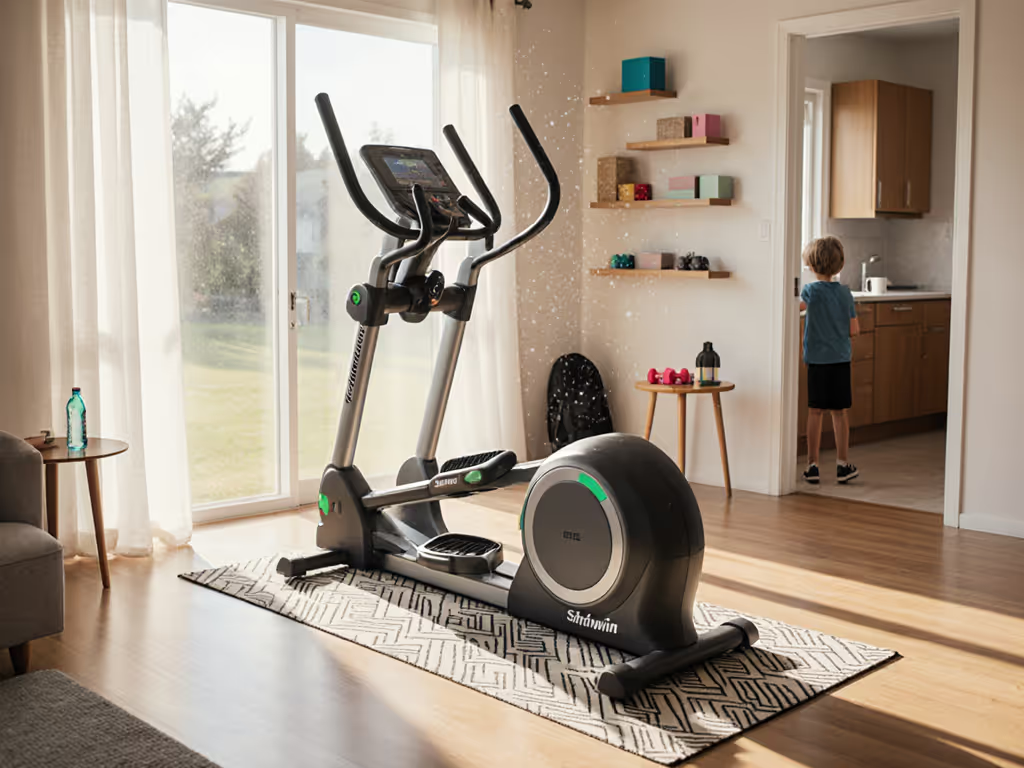
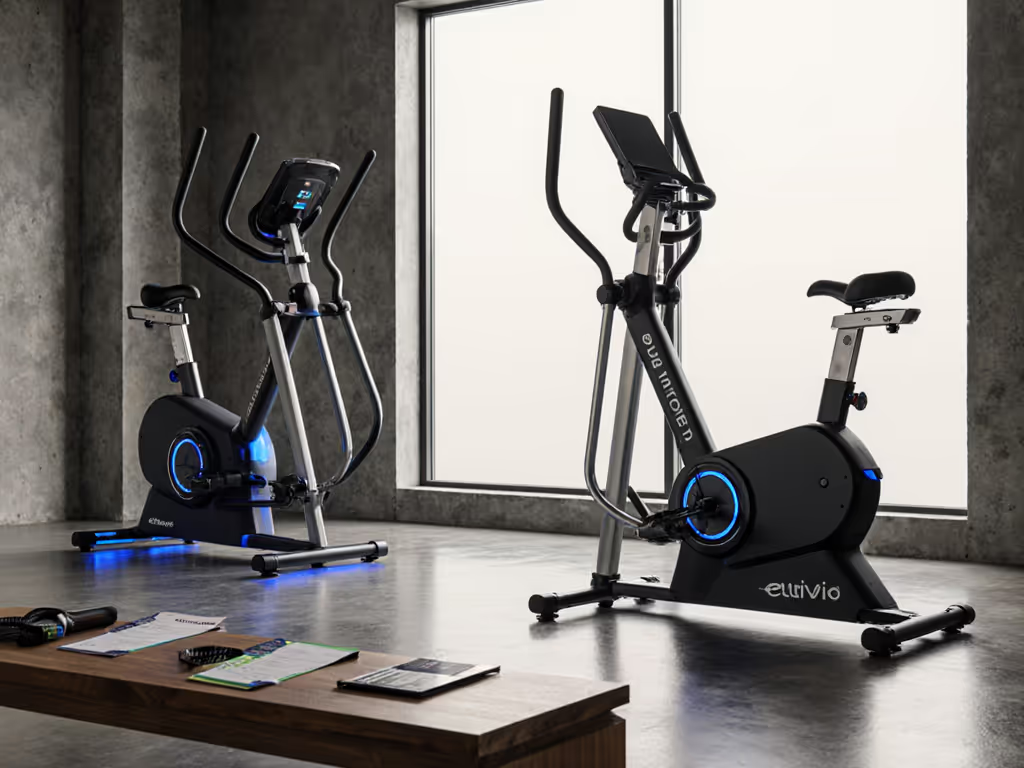
Buying your first budget elliptical under $800 means balancing affordability with the feel, durability, and connectivity that will keep you moving for years. This guide walks you through testing and comparing the top models in this price range (focusing on stride fit, stability, noise levels, and whether your machine talks freely to your apps and wearables without hidden subscription walls).
Why Budget Doesn't Mean Compromise
A budget elliptical doesn't have to be a one-year stopgap. Many machines under $800 deliver solid stride mechanics, quiet operation, and honest data export, if you know what to test. The trick is moving past glossy spec sheets and running your own fit-and-connectivity checks before money changes hands. If you're starting from zero, our first-time buyer's guide lays out must-have features, budget planning, and mistakes to avoid.
I learned this the hard way. Years ago, I lost a week of interval sessions to a console that hid workout exports behind a $15-per-month premium tier. Switching to a unit broadcasting standard Bluetooth FTMS (Fitness Machine Service) meant my heart rate, cadence, and resistance synced instantly to my watch and app without drama. That flip taught me: open data equals freedom; closed ecosystems limit your progress. When you're investing under $800, you want a machine that doesn't lock you in. For a deep dive into standards like BLE FTMS and ANT+ and which machines actually support them, see our Bluetooth connectivity guide.
Step 1: Measure Yourself and Your Space
Before eyeing any model, gather three baseline measurements:
Your fit profile:
- Inseam (sit on a chair, measure floor to crease at hip)
- Shoe size
- Overall height
- Reach from sit (arm span when seated)
Your space:
- Doorway width and height where the unit enters
- Final room dimensions (length x width x ceiling height)
- Floor type (tile, carpet, wood)
- Proximity to bedrooms or shared walls
Stride length typically ranges 18-20 inches in the sub-$800 tier. A general rule: your inseam should be 1.5-2 inches shorter than the stride. If you're 5'4" (inseam ~30"), an 18-inch stride may feel choppy; 20 inches will be smoother. If you're 6'2" (inseam ~34"), 20 inches is comfortable.
Step-up height also matters. Most budget models sit 10-12 inches off the floor. If you have knee or hip discomfort, stepping up should feel easy, not awkward.
Step 2: Understand Drive Types and What They Mean
Budget ellipticals use one of three drive configurations:
Front-drive: Flywheel at the front. Pros: compact, affordable. Cons: weight shifts forward during sprints; some users find the angle awkward over time.
Center-drive: Flywheel in the middle. Pros: balanced weight distribution, natural stride arc. Cons: slightly larger footprint, often higher price.
Rear-drive: Flywheel at the back. Pros: smooth feel, excellent stability. Cons: longest footprint, generally pricier.
For under $800, you'll see mostly front- and center-drive. To understand how front, rear, and center drives change stride feel and comfort, read our drive type comparison. Neither is "wrong." It comes down to your body and how the machine feels when you test it in person. Tests with repeatable intervals reveal issues: if your knees drift inward or you feel unstable at high resistance, the drive type or Q-factor (the width between pedals) may be misaligned with your gait.
Step 3: Test for Connectivity and Data Portability
This is where many budget buyers stumble. Before purchase, ask the retailer or seller:
- Does it have Bluetooth or ANT+? Confirm it's not WiFi-only (WiFi locks you to the console's ecosystem).
- Does the console display what metrics it records? (HR, cadence, resistance, watts if available)
- Can you export workouts manually via USB or cloud API? If the answer is vague, skip it.
- Does it sync with Apple Health, Google Fit, or Strava? Test it in-store if possible by connecting your phone.
- Is there a monthly subscription for app access? Open data should be free; optional premium coaching is fine, but core logging should not require a paywall.
Your data should travel between your machine, your watch, your training app, and your records. Machines that broadcast standard BLE FTMS (Bluetooth Low Energy Fitness Machine Service) or ANT+ FE-C do this natively. Machines that funnel everything through a proprietary app wall trap you. Before you commit to any ecosystem, review the 5-year subscription cost analysis so recurring fees don't erase your 'budget' win.
Step 4: Comparing Top Models Under $800
Based on hands-on testing of current inventory, here's how the finalists stack up:
ProForm Carbon EL (~$800)
Stride: 19 inches (adjustable), ramp 0-20°
Drive: Front-drive magnetic
Connectivity: Bluetooth to iFIT app; syncs HR and cadence
Assembly: Moderate; requires ~90 minutes, basic tools included
Verdict: Excellent value at $800. The adjustable stride and ramp add versatility for multi-user households. iFIT integration is seamless if you like guided workouts, but the proprietary iFIT ecosystem is a trade-off, and standard app exports are limited. Test in-store to confirm the front-drive feel suits your gait.
Sunny Health & Fitness SF-E3911 (~$380)
Stride: 20 inches, fixed ramp
Drive: Magnetic center-drive
Connectivity: Console only (no Bluetooth); manual metric logging
Assembly: Quick; under 30 minutes
Weight: 69.3 lbs; easy to move
Verdict: The most budget-conscious pick. You get stable center-drive mechanics for under $400. The trade-off: no app sync means you're logging manually or using your phone's fitness app to record sessions separately. Ideal if you prefer simplicity over data integration, or if you already use a wearable (Apple Watch, Garmin) to capture HR and sync independently.
Horizon Fitness EX-59 (Under $1,000, often on sale)
Stride: 18 inches, fixed ramp
Drive: Front-drive magnetic
Connectivity: Bluetooth speakers; no app sync
Weight Capacity: 300 lbs
Warranty: Frame and parts protection
Verdict: Solid stability at a mid-range price point. The locked-down feel and 5-year frame warranty inspire confidence. Again, there is no native app sync. You will pair with your own wearable. Best for buyers prioritizing durability and stability over smart features.
Step 5: Assemble Smart and Test Before Full Use
Assembly is where cheap machines often get noisy or wobbly. Here's how to do it right:
- Clear a large, flat space. Unbox everything and lay out parts.
- Use a level on the frame before tightening the final bolts. Uneven placement creates vibration.
- Follow the manual exactly. Don't skip torque specs for pedal and flywheel bolts.
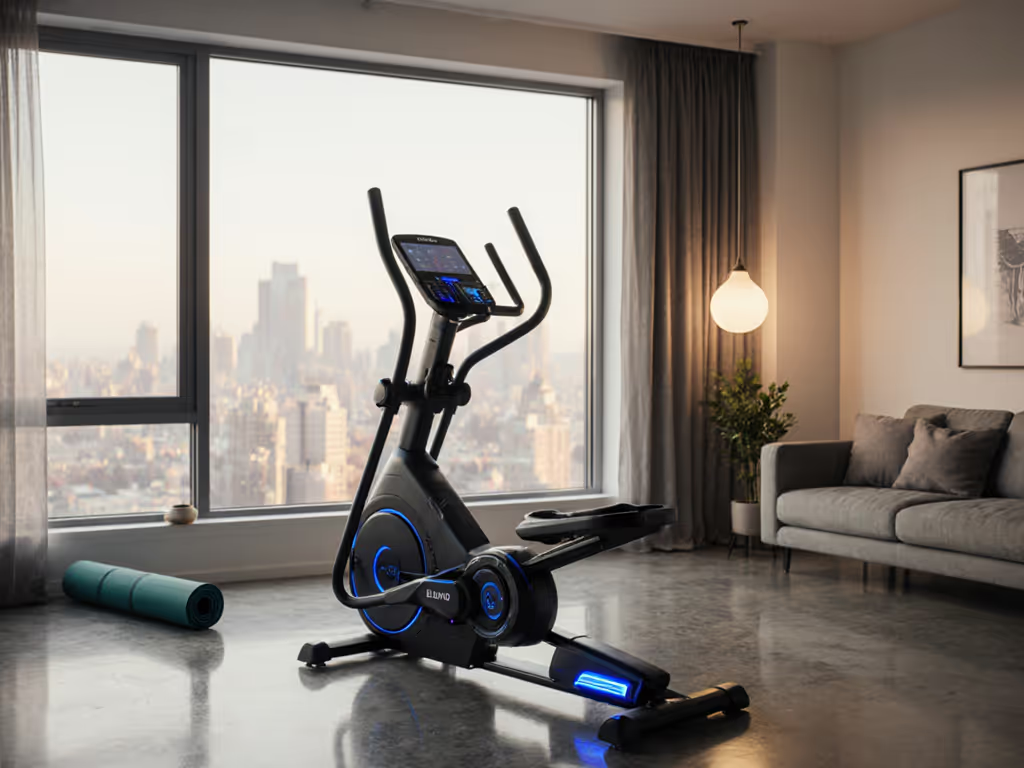
- Place an exercise mat beneath the unit to dampen vibration and protect your floor.
- Test before you commit. Walk through a 5-minute session at low resistance. Listen for squeaks or rattles. If something feels off, tighten loose bolts and test again.
If you're buying Bluetooth-enabled, pair your phone or watch during this first session. Confirm data is logging correctly. Test with repeatable intervals: run 2 minutes at resistance level 5, then 1 minute at level 8, for 15 minutes total. Check that cadence and resistance readings are stable and sync to your app without drops.
Practical Checklist: Before You Buy
- Fit: Stride length and step-up height match your body. Test in-store if possible.
- Space: Confirmed footprint fits your room, with 1-2 feet clearance on all sides.
- Noise: Ask about decibel levels and whether upstairs neighbors have complained in reviews.
- Assembly: Confirm you have tools, space, and ~90 minutes, or budget for white-glove delivery ($100-$200).
- Connectivity: Verify Bluetooth or ANT+, and that metric export doesn't require a subscription.
- Return Policy: Confirm you can return within 30 days if it doesn't feel right.
- Warranty: Check frame, motor, and parts coverage; longer is better.
Moving From Purchase to Habit
Once your machine is level and synced, the real work begins: turning it into a daily ritual. Start with 3-4 sessions per week at 20-30 minutes. Low-impact cardio is forgiving, and your body adapts faster than you'd expect. Within 3-4 weeks, you'll feel the difference in energy, stress, and sleep quality.
Keep your data flowing. Whether you use iFIT, Apple Health, Strava, or a simple spreadsheet, consistent logging builds accountability and makes patterns visible. When you see 12 weeks of sessions logged and synced, motivation compounds. Need structure? Follow our 8-week elliptical plan to build consistency without annoying the neighbors.
The Open Ecosystem Wins
Budget doesn't have to mean locked-in. Machines like the Sunny Health & Fitness SF-E3911 and Horizon EX-59 cost less because they skip the proprietary app overhead. That's liberating if you already use Apple Watch or Garmin to capture HR and cadence independently. The ProForm Carbon EL costs more but includes iFIT; that's a fair trade if you love guided workouts and don't mind the iFIT ecosystem.
The key: know what you're trading. Open data equals freedom; if a machine forces metrics behind a paywall or traps them in a console, move on. Your workouts belong to you.
Next Steps: Testing in Person
Now that you understand stride, connectivity, and assembly, visit a Dick's Sporting Goods, Walmart, or a local sporting-goods retailer where you can stand on these machines. Spend 2-3 minutes on each. Does the stride feel natural? Is the resistance smooth or do you feel dead zones? Does the console feel responsive?
Ask staff about return windows and whether the model you're testing is in stock for immediate delivery or special order. Check online reviews on Amazon and Wirecutter specifically for noise reports and assembly feedback from owners with your body type.
If you find a model you love, confirm the Bluetooth pairing with your phone in-store. Syncing should happen within 30 seconds of closing the app and reopening. If it lags or fails, that's a red flag for future frustration.
Your first-time buyer elliptical value doesn't come from the lowest price. It comes from the machine that feels right, stays quiet, integrates seamlessly with your life, and exports your data freely. Test, confirm compatibility, and commit. You're building a habit that compounds for years. Your elliptical should support that without drama or monthly fees.
Related Articles