Sole E25 Review: Bluetooth Elliptical Without Subscription Lock
By Aiko Tanaka • 27th Mar
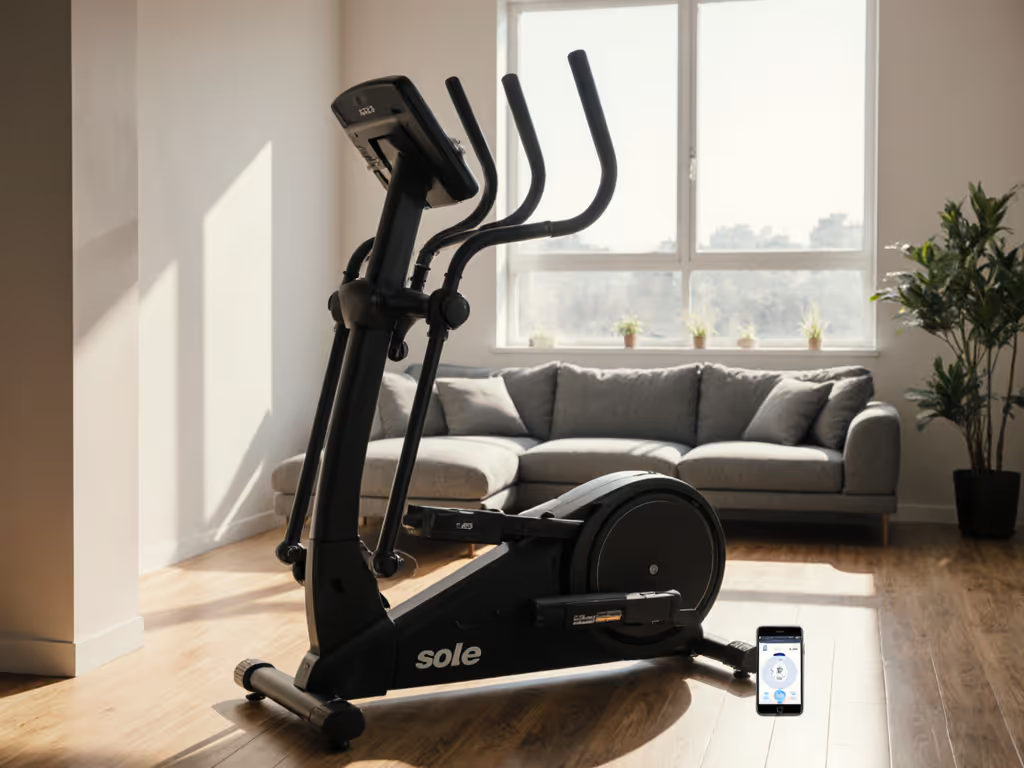
The Sole E25 review landscape has shifted. Buyers now expect open ecosystem fitness machines that won't lock them into proprietary subscriptions or ecosystem hostage situations. The Sole E25 Bluetooth features and Sole+ app integration story is more nuanced than marketing suggests (and worth examining critically), especially for apartment dwellers and neighbor-conscious users looking for real value. This compact elliptical checks boxes that matter: quiet operation, genuine open connectivity, and a clear footprint that respects apartment constraints. But skepticism is warranted. Let's break down what this machine actually delivers against its claims and your space.
1. Build Quality and Stability: Does It Really Stay Put?
The Sole E25 features a steel frame rated for 350 pounds, with six stabilizers (four adjustable via wrench at the rear). This is where skepticism kicks in: some reviewers observed "ever so slight" movement despite the stated weight capacity, attributed to missing floor stabilizers from the factory package.
That admission matters. Stability first, then speed, but only if the machine actually delivers on "first." The frame itself is durable with black powder coating for sweat resistance, and the 20-pound flywheel provides solid, smooth motion. However, relying on four adjustable rear feet to lock a 209-pound machine is a gamble in apartments, especially on hard flooring or plywood subfloors typical of older rental units.
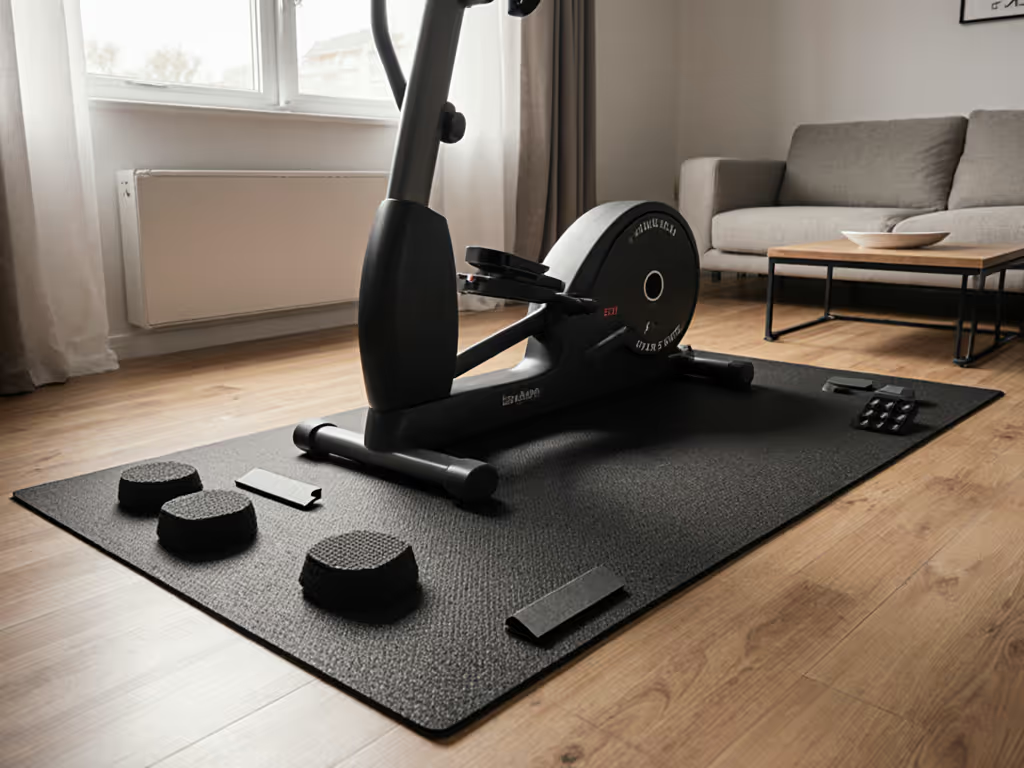
Critical take: You'll need to budget an extra $30 to $60 for a dense anti-vibration mat (rubber or composite, minimum 3/8-inch) and likely rubber shims to level the rear feet properly. Without these, your stability claim rests on assumptions about your floor. Document baseline vibration with a phone SPL app at idle (you're looking for sub-30 dB) before and after mat placement. It's portable engineering, not a defect.
2. Footprint and Spatial Reality: Compact, But Is It Compact Enough?
The E25 measures 70 inches long × 24 inches wide × 70 inches tall. In metric: roughly 178 cm × 61 cm × 178 cm. This is genuinely one of Sole's most compact frames, marketed as 'smaller' and praised for fitting 'tighter spaces.'
Here's the skeptical lens: 70 inches is still 5 feet 10 inches. A standard doorway is 32 inches; the E25 is 24 inches wide, so it threads through most residential doors if angled diagonally. But the 70-inch height means you need a ceiling clearance of at least 7 feet 2 inches for any dynamic movement, and ideally 7 feet 6 inches for safety margin during high-cadence or incline work.
For 8-foot ceilings (common in basements and apartments), you'll clear your head, but not comfortably. For 7-foot ceilings, this machine is a no-go.
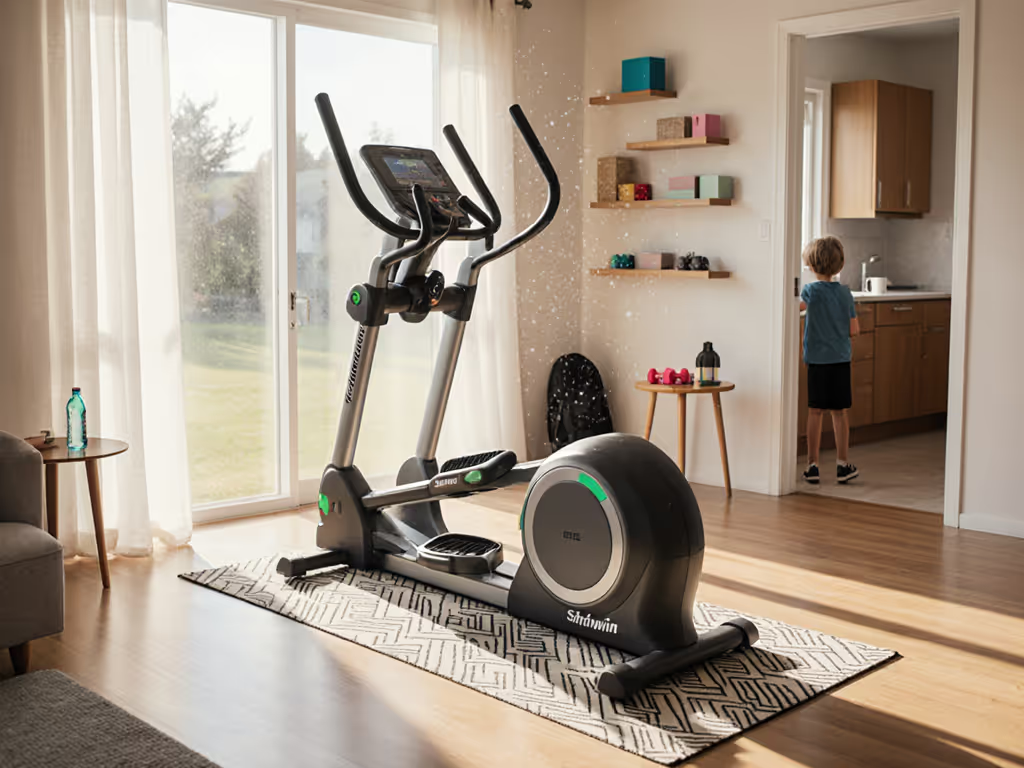
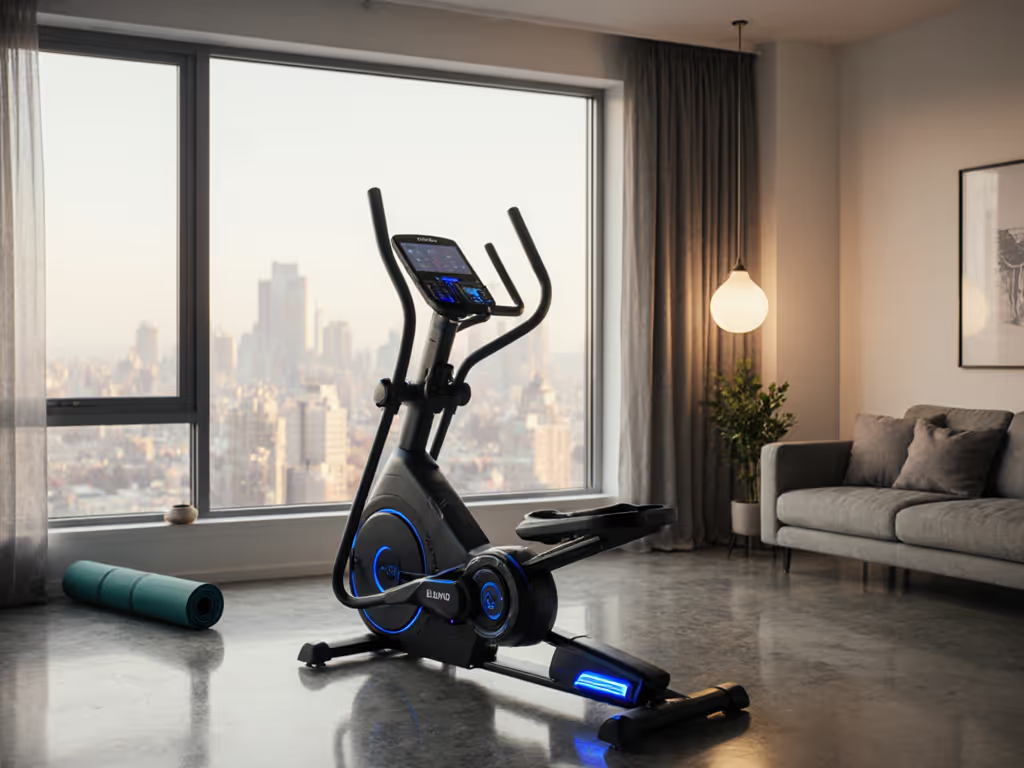
Footprint in practice: place it in a spare bedroom or office, and it occupies roughly 70" × 24" of floor space (similar to a small desk). The front-drive design means you're not fighting a massive rear footprint like center-drive competitors. That's legitimate value if you're measuring your living room in inches.
Critical take: Measure your doorway width, measure your ceiling height, and physically walk the machine's footprint on your floor (using tape and a broom handle as a mock frame). Don't rely on video reviews shot in spacious gym studios. For space planning beyond specs, see our compact elliptical guide.
3. Noise Performance: Where Aiko's First Apartment Elliptical Matters Most
The E25 uses magnetic resistance, which means no belt slap and no grinding. It's described as "really quiet" and produces "pleasant" sounds when pedaled. But "quiet" is vague. My first apartment elliptical drew a polite note from downstairs. I borrowed a phone SPL meter, added a dense mat and risers, and documented a 7 to 9 dB drop at typical cadence. That moment convinced me: quiet is a spec you can engineer, and it should be part of every buying decision.
For the E25, the front-drive motor and 20-pound flywheel are genuinely lower-noise components than heavier, belt-driven units. But real-world testing in apartments or townhomes with shared floors is rare in reviews. The absence of included floor stabilizers is a red flag for vibration transmission, so you're relying on your mat and rear feet adjustment.
Critical take: Before purchase, ask the retailer or Sole directly for realistic SPL readings at cadence (footfall noise, not just motor noise) at 80 rpm and 120 rpm on a rigid floor. Expect 65 to 72 dB at moderate cadence if properly isolated. Assume you'll spend $40 to $80 on isolation accessories. If you're upstairs in a multiunit building, budget another week to level and dampen properly.
4. Stride Length, Step-Up Height, and Fit Variability: The Multi-User Challenge
The Sole E25 offers a 20-inch stride length, pedals sized at 6" × 15", with a 20-inch seat-to-handlebar reach via the standard Sole geometry. This is not adjustable.
For the audience: most users 5'6" to 6'1" will find this comfortable. Shorter users (under 5'4") often praise the E25 precisely because the narrower frame and smaller geometry feel natural. Taller users (over 6'2") may feel cramped, and reviewers note they should target a 22-inch stride model.
Critically, this is where couples or multi-user homes hit friction. If multiple people will share one machine, review our multi-user setup guide for profile features and quick-fit adjustments that matter. If you're a 5'3" partner and your co-user is 6'2", the E25 is not a one-machine solution. The step-up height (distance from floor to pedal at lowest point) is standard Sole, around 10 to 11 inches (fine for most, but tight for users with limited mobility or joint restrictions).
Critical take: Both intended users should physically try a Sole E25 or similar-geometry machine at a gym or showroom. Measure your inseam (inside leg from crotch to ankle) and compare to the 20-inch stride. If your inseam is under 28 inches, the E25 suits you. If it's over 32 inches, consider a larger model despite the footprint trade-off. Don't buy for a partner's future fit; buy for today's body.
5. Resistance and Incline Range: Are 20 Levels Enough?
The E25 includes 20 magnetic resistance levels and 20 incline levels, manually selectable via console buttons or arm controls.
For context: 20 levels is robust. Entry-level ellipticals top out at 8 to 12 levels; mid-range machines offer 16 to 20; premium models push 25+. The jump from level 1 to level 2 on the E25 is subtle, good for recovery and beginner adaptation. Levels 15 to 20 demand legitimate effort, suitable for high-intensity interval work.
Incline on ellipticals is often oversold. On the E25, the incline targets glutes and quads differently but does not meaningfully increase overall metabolic demand the way a treadmill incline does. It's a muscle engagement tool, not a difficulty multiplier. Useful, but not transformative.
Critical take: For most users 3 to 5 sessions per week, 20 resistance levels offer sufficient progression over 18 months. You won't outgrow this machine for foundational cardio. If you're pursuing VO2 max or elite endurance, consider machines with heavier flywheels (25 to 30 lbs) despite footprint trade-offs.
6. Bluetooth, Connectivity, and the Subscription Trap
Here's where the E25 title, "Without Subscription Lock," requires honest assessment. The machine includes:
- Bluetooth-compatible speakers for audio streaming
- Tablet holder for watching content
- Basic 6.5-inch LCD display with onboard stat tracking (time, distance, calories, cadence, heart rate via pulse sensors)
- Pulse sensors and an included chest strap for HR monitoring
What's missing from public materials is detailed clarity on "Sole+ app integration." The E25 has Bluetooth capability, but the specific integration with Sole's app ecosystem (whether it's open or gated, free or paid) isn't always made explicit in available reviews. This is a critical gap.
Critical observation: The E25 doesn't force you into an app or subscription. You can train entirely on the console. You can pair Bluetooth speakers and stream podcasts or music. You can use a tablet stand and watch Netflix. The "without subscription lock" claim holds true, and Sole isn't demanding a monthly membership to use your machine. That's more than many competitors offer. To understand why avoiding lock-ins matters long-term, see the 5-year subscription cost analysis.
However, if you want Sole+ integration (workouts, coaching, leaderboards), you'd need to check current pricing and terms directly with Sole. The E25's low-end console suggests limited integration. For Strava, Apple Health, or Google Fit syncing, you'd likely input data manually or use a third-party app, which is fine for committed users and friction-free only if you don't care much about ecosystem logging.
Critical take: The E25 is open and optional, not closed and mandatory. That's the consumer win. But it also means you're not getting premium app experiences built in. Pair this with Strava's free tier, Apple Health, or a simple spreadsheet. Don't buy this machine expecting seamless Sole+ integration; buy it because you don't need to be locked in.
7. Warranty and Long-Term Ownership Reality
Sole backs the E25 with:
- Lifetime warranty: frame and flywheel
- 2-year warranty: components (motor, electronics)
- 1-year labor warranty: covered parts replacements
- 90-day cosmetic warranty: covers finish defects
This is above-average for the price point (around $1,000). Compare coverage differences across brands in our elliptical warranty terms analysis. The lifetime frame coverage is genuine peace of mind for 5 to 10 year ownership. However, and this is critical, "lifetime" covers defects, not wear. Bushings, bearings, seat padding, and non-structural parts deteriorate through normal use. The 2-year parts window means you're responsible for motor or resistance-unit failures after 24 months.
Assembly hassle is documented: one reviewer noted "difficult assembly with confusing instructions." Budget 2 to 3 hours and either strong DIY confidence or $100 to $150 for white-glove assembly if you're not mechanically inclined.
Critical take: The warranty justifies the price, but only if you accept that maintenance kicks in year 3. Expect to replace pedal straps, potentially recalibrate resistance, and possibly upgrade the seat cover or handlebar padding. These are $20 to $80 costs, not deal-breakers, but they're real. Budget $200 over 5 years for wear items.
8. Value Assessment: The Core Question
Priced around $1,000 to $1,200, the Sole E25 sits in the sweet spot for confident buyers:
- Under $1,200: Entry-level to mid-market price
- Front-drive magnetic resistance: Quiet, smooth, low-maintenance
- Compact footprint: Fits apartments and spare rooms
- 350-pound capacity: Inclusive weight range
- Lifetime frame warranty: Long-term confidence
- No subscription mandate: You control your ecosystem
What it doesn't offer:
- Touchscreen or AI coaching
- Smart incline auto-adjustment
- Premium app ecosystem
- Heaviest-in-class flywheel smoothness
- Adjustable stride length
For a couple or individual returning to fitness, focused on consistent 3 to 5 weekly sessions in a shared-wall or upstairs apartment, the E25 is genuinely good value. It won't become a noisy liability. It won't demand annual app fees. It will feel smooth and stable if you spend an hour setting it up properly.
For users seeking heavy-duty HIIT programming, app-guided coaching, or adjustable geometry, you'll want to stretch to $1,500 to $2,000 for a mid-tier Sole (e.g., E35, E45) or a premium competitor.
Critical take: The E25 is not a compromise machine. It's a focused machine. Know what you actually want (consistent cardio, neighbor-friendly operation, open connectivity, and durability), and it delivers. Expect something else, and you'll feel shortchanged.
Your Next Step: Verification Checklist
Before buying, work through this actionable sequence:
- Measure your space: doorway width, ceiling height, floor type (carpet/wood/concrete). Document baseline noise level (phone SPL app, idle room).
- Fit test: Visit a Sole dealer or gym with an E25 or comparable-geometry machine. Stand on it, pedal for 2 minutes. Does the stride feel natural? Do the handles fit your hand span?
- Isolation plan: Identify where you'll place it, what mat you'll use (budget $50 to $80 for quality rubber), and confirm rear-foot adjustment clarity with the retailer.
- App reality-check: Clarify with Sole support whether Sole+ integration is available on the E25 and what the current cost structure is. If app tracking matters, confirm you'll accept manual logging or third-party tools.
- Assembly backup: Decide: DIY with video guides, or white-glove delivery (about $150)? Budget time and realistic mechanical confidence.
- Return policy: Confirm the retailer allows 30 to 60 day home trials. If it doesn't feel right at day 10, you want an exit.
Once you've cleared these steps, the E25 is a defensible buy for quiet, compact, neighbor-friendly cardio. Order with confidence, then invest the first week in proper setup (that's where the quiet spec actually lives).
--
Bottom line: The Sole E25 is a well-built, genuinely quiet, and refreshingly subscription-free compact elliptical that suits apartment and space-conscious buyers willing to spend an hour on isolation and setup. It's not the fanciest machine, and it won't adjust itself to your height, but it will work reliably for 5 to 10 years without locking you into an ecosystem. That clarity is rare and worth the $1,000 to $1,200 investment if your actual fitness goal is consistent, low-impact cardio in a tight space. Measure twice, buy once, and set it up right from day one.
Related Articles